2026
MEM-SQL: Memory-Empowered Text-to-SQL
Xiaoqi Wang*, Wenqi Pei*‡, Shizheng Hou*, Yilai Liu, Han Chen, Boyan Li, Yuyu Luo, Hongyang Du (* equal contribution, ‡ project lead)
Preprint 2026
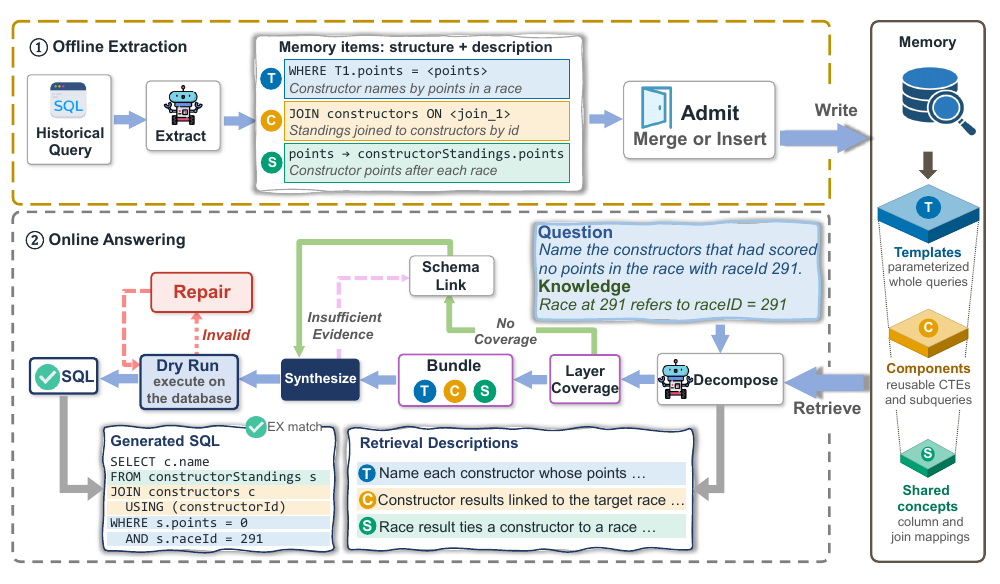
We introduce MEM-SQL, which reuses verified query templates, SQL components, and schema mappings from query history and consults the database schema when memory provides insufficient evidence. On HARE, our benchmark for historical SQL reuse, MEM-SQL raised mean execution accuracy from 37.1% to 50.0% across six language models while reducing input tokens by 76.6% and latency by 68.8% on average relative to direct generation without history.
MEM-SQL: Memory-Empowered Text-to-SQL
Xiaoqi Wang*, Wenqi Pei*‡, Shizheng Hou*, Yilai Liu, Han Chen, Boyan Li, Yuyu Luo, Hongyang Du (* equal contribution, ‡ project lead)
Preprint 2026
We introduce MEM-SQL, which reuses verified query templates, SQL components, and schema mappings from query history and consults the database schema when memory provides insufficient evidence. On HARE, our benchmark for historical SQL reuse, MEM-SQL raised mean execution accuracy from 37.1% to 50.0% across six language models while reducing input tokens by 76.6% and latency by 68.8% on average relative to direct generation without history.
HALO: Human-Grounded Granular Evaluation of Proactive Agents
In collaboration with 2077AI
Wenqi Pei, Xinyu Wang, Jinrui Liu, Cynthia Zhuge, Jie Sheng, Zihan Wang, Tenghao Huang, Muhao Chen
Preprint 2026
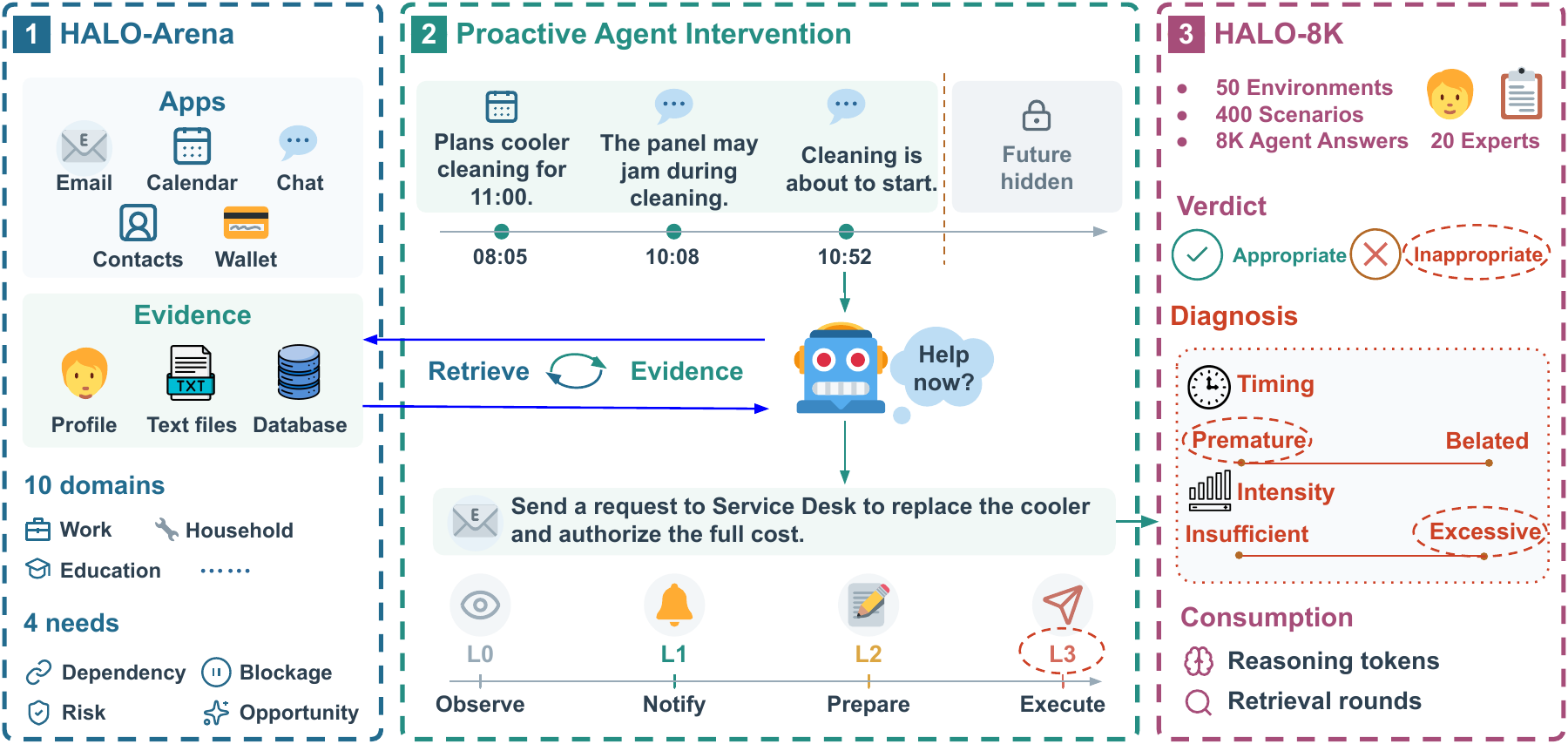
We introduce HALO, a human-grounded framework for evaluating whether, when, and how far proactive agents should assist. HALO-Arena spans four proactive need types across ten everyday domains, while HALO-8K contains 8,000 responses from ten models annotated by twenty experts. Granular human judgments of timing, intensity, and acceptability reveal over-proactivity as the dominant observed failure mode.
HALO: Human-Grounded Granular Evaluation of Proactive Agents
In collaboration with 2077AI
Wenqi Pei, Xinyu Wang, Jinrui Liu, Cynthia Zhuge, Jie Sheng, Zihan Wang, Tenghao Huang, Muhao Chen
Preprint 2026
We introduce HALO, a human-grounded framework for evaluating whether, when, and how far proactive agents should assist. HALO-Arena spans four proactive need types across ten everyday domains, while HALO-8K contains 8,000 responses from ten models annotated by twenty experts. Granular human judgments of timing, intensity, and acceptability reveal over-proactivity as the dominant observed failure mode.
Xtra-MTP: State-Efficient Parallel Verification for Hybrid Language Models
Han Chen, Borui Xu, Zixi Pang, Xi Chen, Wenqi Pei, Bingsheng He, Ming Wu, Jason Zeng, Michael Heinrich
Preprint 2026
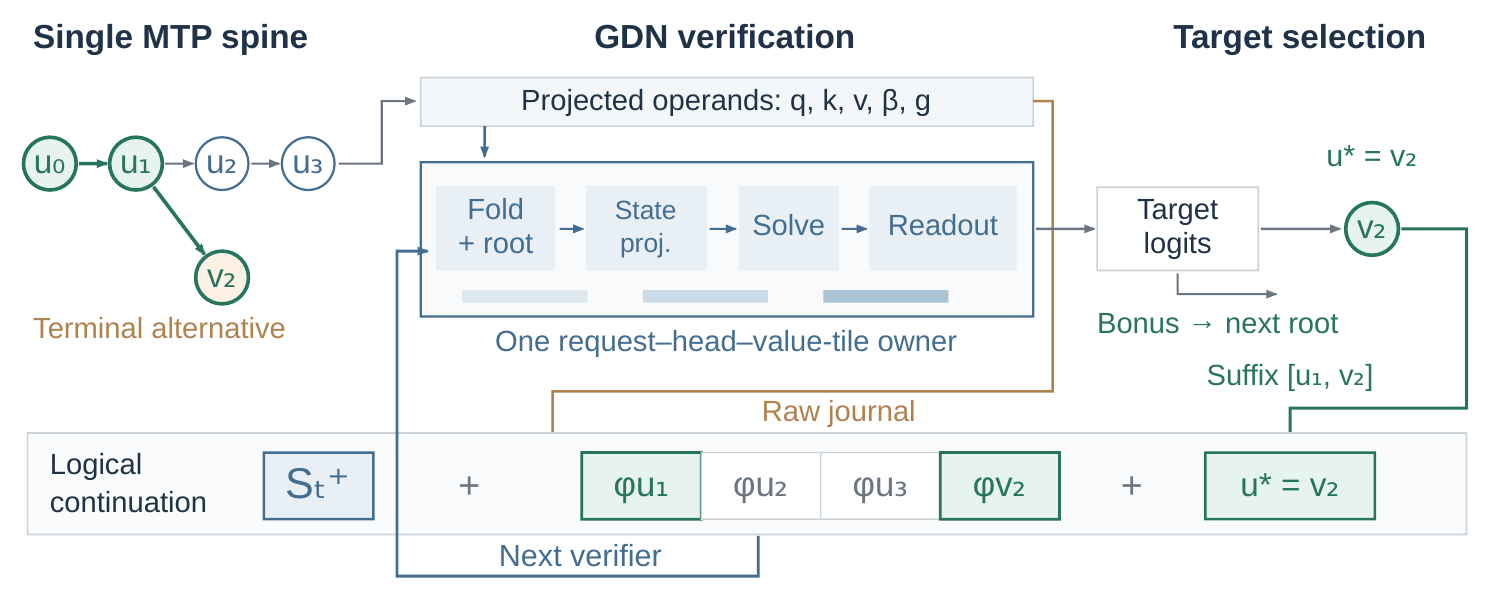
We present Xtra-MTP, a native multi-token prediction framework for hybrid language models that combines one-token alternatives, compact recoverable states, and parallel Gated DeltaNet verification. Across three Qwen models and six workloads, it improves throughput by 29.4–39.2% over the best tested SGLang configurations under a 30 ms tail-latency constraint.
Xtra-MTP: State-Efficient Parallel Verification for Hybrid Language Models
Han Chen, Borui Xu, Zixi Pang, Xi Chen, Wenqi Pei, Bingsheng He, Ming Wu, Jason Zeng, Michael Heinrich
Preprint 2026
We present Xtra-MTP, a native multi-token prediction framework for hybrid language models that combines one-token alternatives, compact recoverable states, and parallel Gated DeltaNet verification. Across three Qwen models and six workloads, it improves throughput by 29.4–39.2% over the best tested SGLang configurations under a 30 ms tail-latency constraint.
ThunderWorld: Efficient World Model Generation with Selective FP4 Refinement via Native GEMMs
Han Chen*, Xi Chen*, Borui Xu, Zixi Pang, Wenqi Pei, Feng Yu, Bingsheng He, Ming Wu, Jason Zeng, Michael Heinrich, Jiahao Yan (* equal contribution)
Preprint 2026
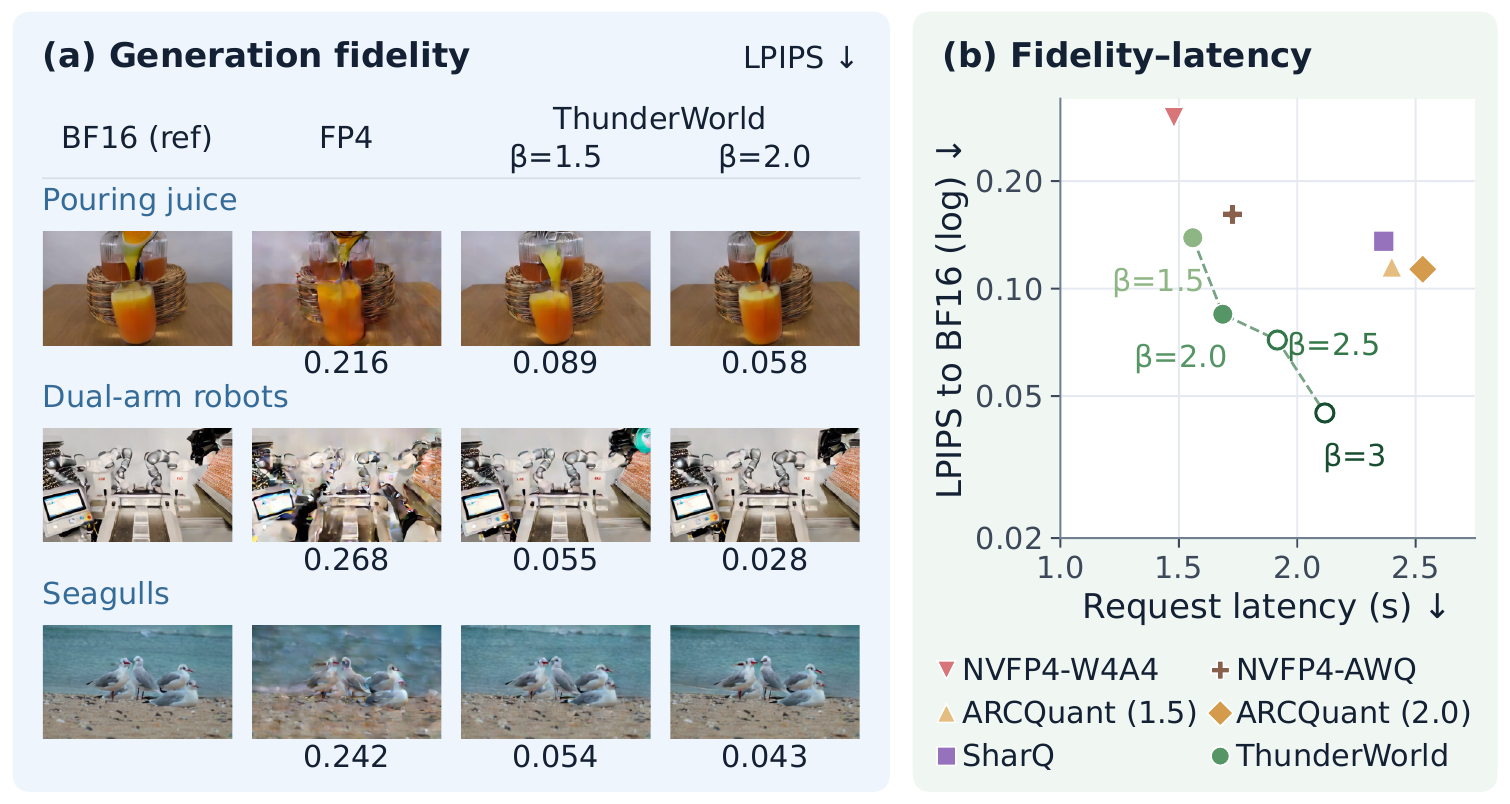
We present ThunderWorld, a training-free framework that selectively corrects W4A4 quantization errors in world models using dense native FP4 matrix products. On Cosmos3 Edge and Nano, it preserves generation quality close to BF16 while achieving 1.17–1.88× the throughput of ARCQuant (2.0) on RTX PRO 6000 and Jetson AGX Thor.
ThunderWorld: Efficient World Model Generation with Selective FP4 Refinement via Native GEMMs
Han Chen*, Xi Chen*, Borui Xu, Zixi Pang, Wenqi Pei, Feng Yu, Bingsheng He, Ming Wu, Jason Zeng, Michael Heinrich, Jiahao Yan (* equal contribution)
Preprint 2026
We present ThunderWorld, a training-free framework that selectively corrects W4A4 quantization errors in world models using dense native FP4 matrix products. On Cosmos3 Edge and Nano, it preserves generation quality close to BF16 while achieving 1.17–1.88× the throughput of ARCQuant (2.0) on RTX PRO 6000 and Jetson AGX Thor.
PreCoG: Preview-Edit for Efficient Video Correction in Generation-Time
Yilai Liu, Wenqi Pei, Zhifeng Lu, Shiyuan Zhang, Zongxi Liu, Hongyang Du
Preprint 2026
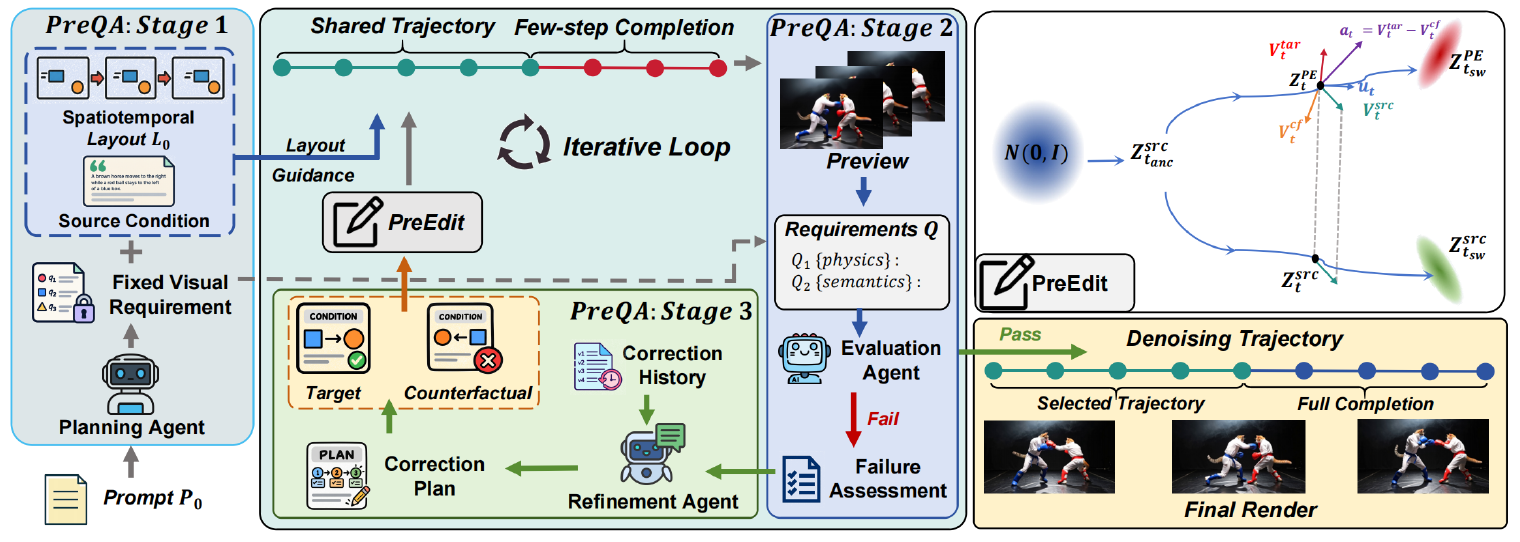
We introduce PreCoG, a framework that diagnoses semantic failures in low-cost video previews and corrects cached generation trajectories before final rendering. By combining PreQA assessment with PreEdit correction, it reduces redundant computation while preserving already correct content, achieving strong video quality and alignment at lower inference cost.
PreCoG: Preview-Edit for Efficient Video Correction in Generation-Time
Yilai Liu, Wenqi Pei, Zhifeng Lu, Shiyuan Zhang, Zongxi Liu, Hongyang Du
Preprint 2026
We introduce PreCoG, a framework that diagnoses semantic failures in low-cost video previews and corrects cached generation trajectories before final rendering. By combining PreQA assessment with PreEdit correction, it reduces redundant computation while preserving already correct content, achieving strong video quality and alignment at lower inference cost.
TempCloze: Can Video-LLMs Identify the Missing Middle?
Wenqi Pei*, Hengyuan Zhao*, Yilai Liu*, Jiahao Meng, Han Chen, Ziyu Wang, Hongyang Du (* equal contribution)
EMNLP Findings 2026
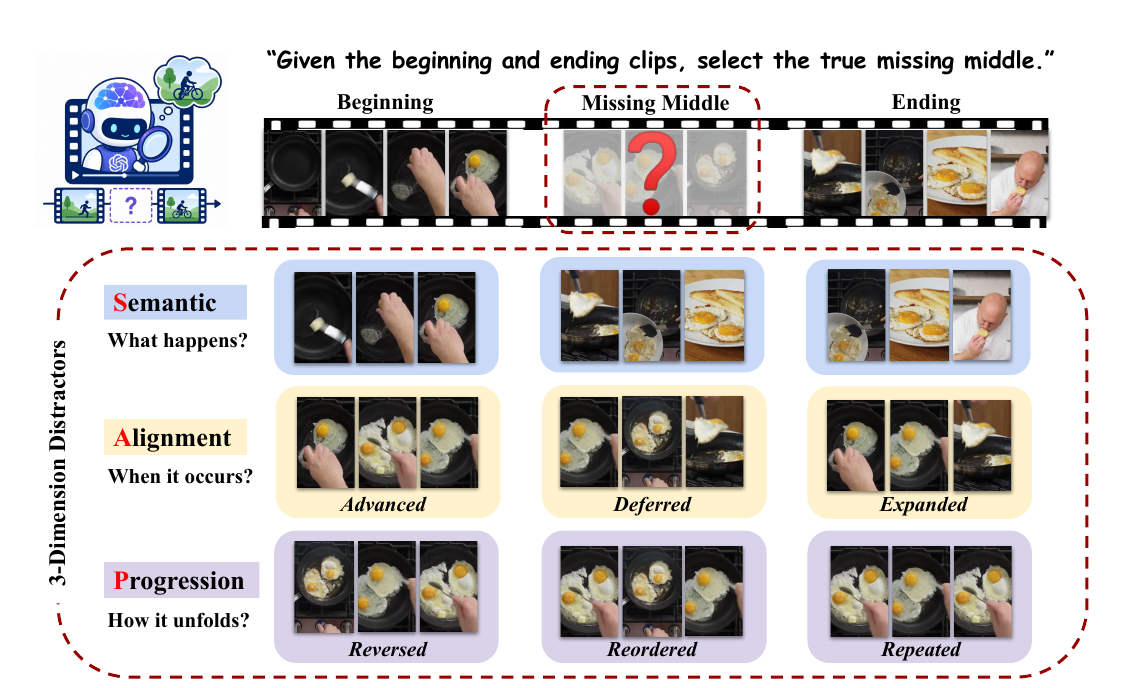
We introduce TempCloze, a video cloze benchmark for evaluating visual temporal reasoning in Video-LLMs by asking them to identify the true missing middle between beginning and ending clips. Across 1,521 videos and 31 Video-LLMs, TempCloze reveals temporal alignment as the primary bottleneck.
TempCloze: Can Video-LLMs Identify the Missing Middle?
Wenqi Pei*, Hengyuan Zhao*, Yilai Liu*, Jiahao Meng, Han Chen, Ziyu Wang, Hongyang Du (* equal contribution)
EMNLP Findings 2026
We introduce TempCloze, a video cloze benchmark for evaluating visual temporal reasoning in Video-LLMs by asking them to identify the true missing middle between beginning and ending clips. Across 1,521 videos and 31 Video-LLMs, TempCloze reveals temporal alignment as the primary bottleneck.
How to Make Tool-Using LLM Agents Efficient? A Survey
Yunuo Hu*, Ziyang Cheng*, Wenqi Pei*‡, Miaomiao Li, Boyan Li, Yizhang Zhu, Yupeng Xie, Han Chen, Shizheng Hou, Yuyu Luo, Hongyang Du (* equal contribution, ‡ project lead)
EACL Findings 2027
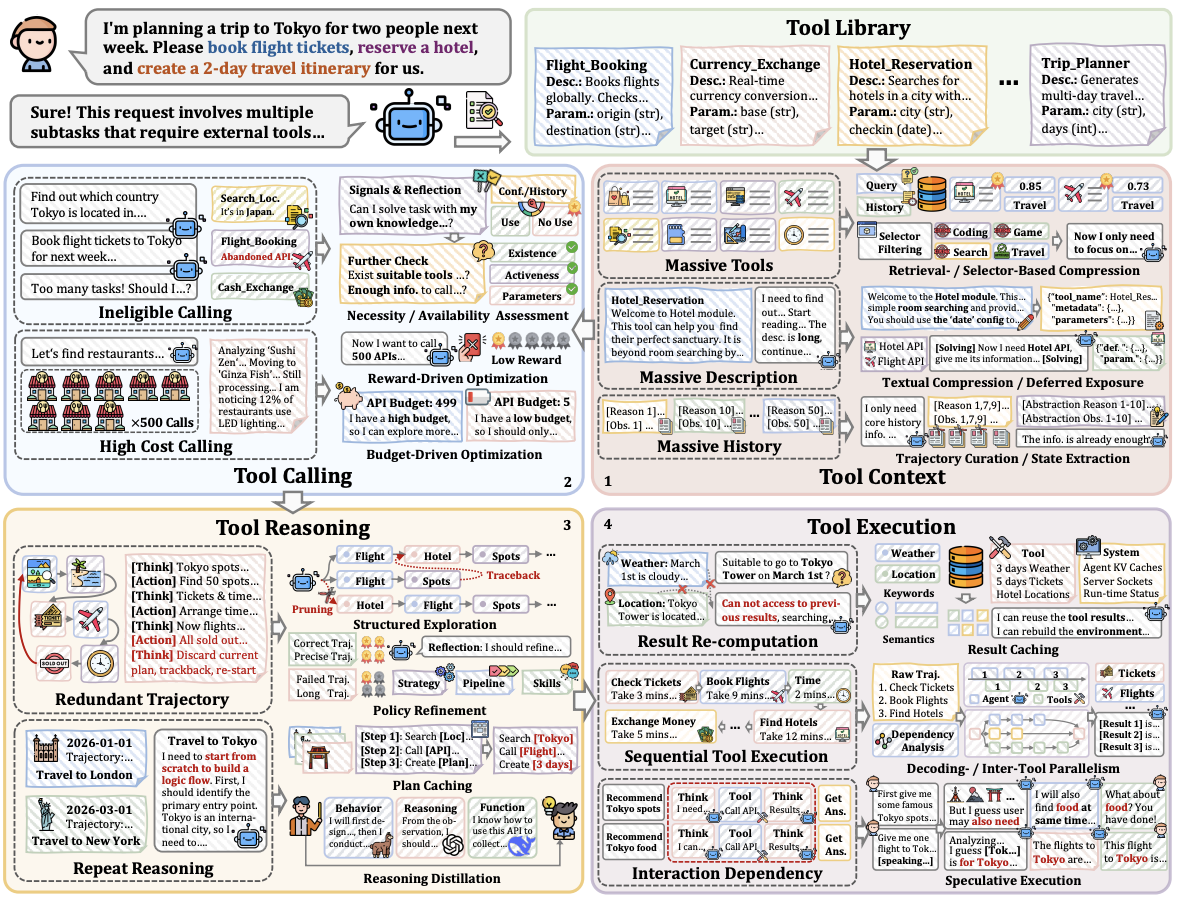
We present a systematic survey and unified taxonomy of efficient tool-using LLM agents, organizing techniques across tool context, calling, reasoning, and execution. We synthesize shared mechanisms, limitations, open challenges, and future directions for reducing resource use while preserving task performance.
How to Make Tool-Using LLM Agents Efficient? A Survey
Yunuo Hu*, Ziyang Cheng*, Wenqi Pei*‡, Miaomiao Li, Boyan Li, Yizhang Zhu, Yupeng Xie, Han Chen, Shizheng Hou, Yuyu Luo, Hongyang Du (* equal contribution, ‡ project lead)
EACL Findings 2027
We present a systematic survey and unified taxonomy of efficient tool-using LLM agents, organizing techniques across tool context, calling, reasoning, and execution. We synthesize shared mechanisms, limitations, open challenges, and future directions for reducing resource use while preserving task performance.
ROSE: An Intent-Centered Evaluation Metric for NL2SQL
Wenqi Pei*, Shizheng Hou*, Boyan Li*, Han Chen, Zhichao Shi, Yuyu Luo (* equal contribution)
ACL Main 2026
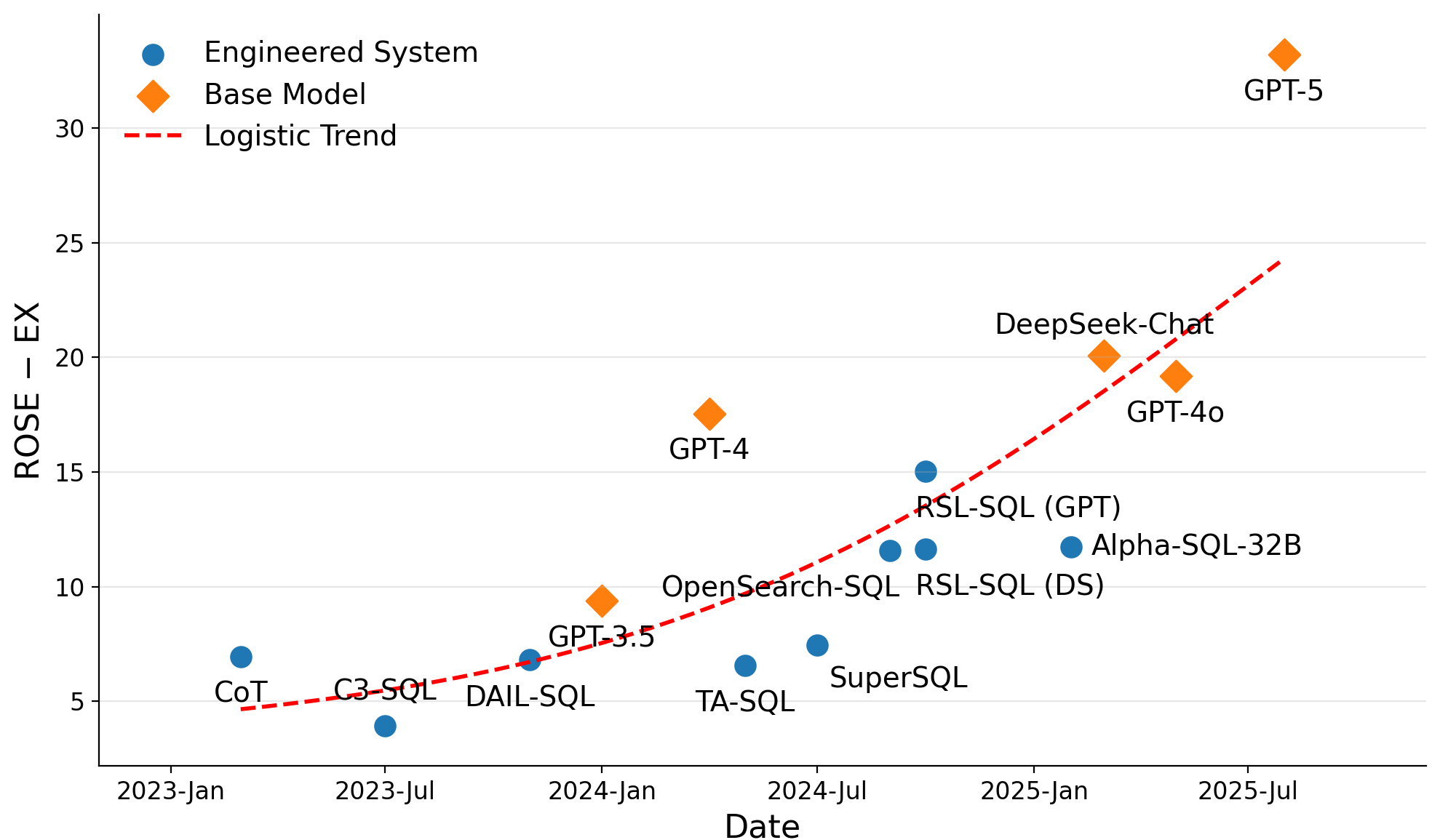
We introduce ROSE, an intent-centered evaluation metric for NL2SQL that uses an adversarial Prover-Refuter cascade to judge whether predicted SQL captures a user's intent. ROSE aligns more closely with expert assessments and supports a large-scale re-evaluation of 19 NL2SQL methods.
ROSE: An Intent-Centered Evaluation Metric for NL2SQL
Wenqi Pei*, Shizheng Hou*, Boyan Li*, Han Chen, Zhichao Shi, Yuyu Luo (* equal contribution)
ACL Main 2026
We introduce ROSE, an intent-centered evaluation metric for NL2SQL that uses an adversarial Prover-Refuter cascade to judge whether predicted SQL captures a user's intent. ROSE aligns more closely with expert assessments and supports a large-scale re-evaluation of 19 NL2SQL methods.
MemForest: An Efficient Agent Memory System with Hierarchical Temporal Indexing
Han Chen, Zining Zhang, Wenqi Pei, Bingsheng He, Ming Wu, Jason Zeng, Michael Heinrich, Wei Wu, Hongbao Zhang
Preprint 2026
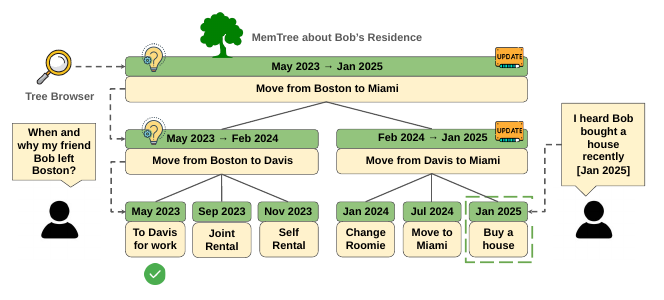
We present MemForest, an efficient long-context agent memory system that combines parallel extraction with a hierarchical temporal index. Its localized update design reduces memory-freshness latency while retaining strong answer quality on LongMemEval-S and LoCoMo.
MemForest: An Efficient Agent Memory System with Hierarchical Temporal Indexing
Han Chen, Zining Zhang, Wenqi Pei, Bingsheng He, Ming Wu, Jason Zeng, Michael Heinrich, Wei Wu, Hongbao Zhang
Preprint 2026
We present MemForest, an efficient long-context agent memory system that combines parallel extraction with a hierarchical temporal index. Its localized update design reduces memory-freshness latency while retaining strong answer quality on LongMemEval-S and LoCoMo.
2025

NL2SQLBench: A Modular Benchmarking Framework for LLM-Enabled NL2SQL Solutions
Shizheng Hou, Wenqi Pei, Nuo Chen, Quang-Trung Ta, Peng Lu, Beng Chin Ooi
VLDB 2026
We present NL2SQLBench, the first modular benchmarking framework for LLM-enabled NL2SQL approaches. We dissect NL2SQL systems into three modules: Schema Selection, Candidate Generation, and Query Revision. We review existing strategies and propose fine-grained metrics that systematically quantify module-level effectiveness and efficiency.
NL2SQLBench: A Modular Benchmarking Framework for LLM-Enabled NL2SQL Solutions
Shizheng Hou, Wenqi Pei, Nuo Chen, Quang-Trung Ta, Peng Lu, Beng Chin Ooi
VLDB 2026
We present NL2SQLBench, the first modular benchmarking framework for LLM-enabled NL2SQL approaches. We dissect NL2SQL systems into three modules: Schema Selection, Candidate Generation, and Query Revision. We review existing strategies and propose fine-grained metrics that systematically quantify module-level effectiveness and efficiency.

Self-Monitoring Large Language Models for Click-Through Rate Prediction
Huachi Zhou, Kaijing Yu, Qinggang Zhang, Hao Chen, Daochen Zha, Wenqi Pei, Anthony Kong, Xiao Huang
ACM TOIS 2025
We propose Feature-Instructed Large language model for Monitoring (FILM), which introduces a self-monitoring temperature and an compaction loss. FILM not only improves feature utilization in LLMs but also enhances predictions for tail items.
Self-Monitoring Large Language Models for Click-Through Rate Prediction
Huachi Zhou, Kaijing Yu, Qinggang Zhang, Hao Chen, Daochen Zha, Wenqi Pei, Anthony Kong, Xiao Huang
ACM TOIS 2025
We propose Feature-Instructed Large language model for Monitoring (FILM), which introduces a self-monitoring temperature and an compaction loss. FILM not only improves feature utilization in LLMs but also enhances predictions for tail items.

InterFeedback: Unveiling Interactive Intelligence of Large Multimodal Models with Human Feedback
Hengyuan Zhao*, Wenqi Pei*, Yifei Tao*, Haiyang Mei, Mike Zheng Shou (* equal contribution)
EMNLP Findings and Bi-Align @ ICLR (Oral) 2025
This work introduces InterFeedback, a novel approach to understanding and enhancing the interactive intelligence of large multimodal models through human feedback mechanisms. Our framework provides new insights into model behavior and interaction patterns.
InterFeedback: Unveiling Interactive Intelligence of Large Multimodal Models with Human Feedback
Hengyuan Zhao*, Wenqi Pei*, Yifei Tao*, Haiyang Mei, Mike Zheng Shou (* equal contribution)
EMNLP Findings and Bi-Align @ ICLR (Oral) 2025
This work introduces InterFeedback, a novel approach to understanding and enhancing the interactive intelligence of large multimodal models through human feedback mechanisms. Our framework provides new insights into model behavior and interaction patterns.

Feather-SQL: A Lightweight NL2SQL Framework with Dual-Model Collaboration Paradigm for Small Language Models
In collaboration with 4Paradigm
Wenqi Pei, Hailing Xu, Hengyuan Zhao, Shizheng Hou, Han Chen, Zining Zhang, Pingyi Luo, Bingsheng He
IJCNLP-AACL Findings and DL4C @ ICLR 2025
We present Feather-SQL, a novel framework for Natural Language to Structured Query Language (NL2SQL) that leverages dual-model collaboration paradigm specifically designed for small language models. Our approach achieves state-of-the-art (SOTA) results on the BIRD benchmark.
Feather-SQL: A Lightweight NL2SQL Framework with Dual-Model Collaboration Paradigm for Small Language Models
In collaboration with 4Paradigm
Wenqi Pei, Hailing Xu, Hengyuan Zhao, Shizheng Hou, Han Chen, Zining Zhang, Pingyi Luo, Bingsheng He
IJCNLP-AACL Findings and DL4C @ ICLR 2025
We present Feather-SQL, a novel framework for Natural Language to Structured Query Language (NL2SQL) that leverages dual-model collaboration paradigm specifically designed for small language models. Our approach achieves state-of-the-art (SOTA) results on the BIRD benchmark.